


Kymeta selected as multi-orbit MILSATCOM provider for U.S. Army’s NGC2 Pilot
Kymeta Corporation was selected as a multi-orbit satellite communications (MILSATCOM) provider for the Next Generation Command and Control (NGC2) Pilot with the firm’s Osprey™ u8 terminal.
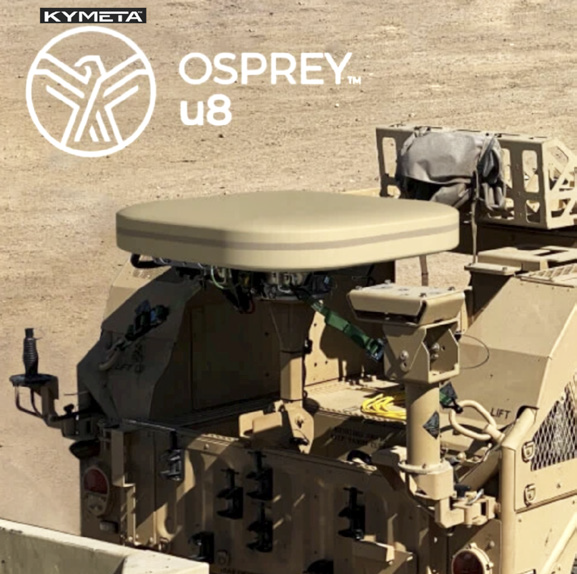 Selected for its battle-proven capabilities and easy-to-use features, all developed with the modern warfighter in mind, Kymeta terminals offer full-duplex data transport, meaning they can receive and transmit from a single aperture. The Osprey u8 provides multi-orbit connectivity across both Geostationary Orbit (GEO) and Low Earth Orbit (LEO) satellite constellations, featuring a modular, cartridge-based system designed for rapid adaptation to evolving mission profiles.
By supporting multiple data pathways, including commercial and government networks, the terminal minimizes dependency on any single source, prioritizing secure interoperability and operational continuity, even in degraded or contested conditions, making it a valuable asset for mission-critical applications.
The U.S. Army’s NGC2 pilot underscores the importance for dispersed teams to stay mobile in increasingly data-centric operations. Kymeta’s technology, based on metamaterials and software-defined features such as proprietary pointing and tracking, enables superior performance and efficiency for Communications On-The-Move (COTM) and Over The Horizon (OTH), thereby increasing the ability for forces to maneuver and remain survivable on the battlefield.
Another critical advantage of Kymeta’s technology is its significantly lower power consumption compared to similar solutions across the industry. This makes it a perfect platform for COTM and contributes to its reduced thermal signature relative to competing technologies. This reduced thermal output combined with other Low Probability of Detection and Intercept (LPD/LPI) features, such as low profile and narrower beamwidth, allow the Osprey u8 to become less detectable when operating in hostile environments.
U.S. Army assessments including ‘Armored Formation Network On The Move,’ ‘Network Modernization Experiment (NETMODX),’ and ‘Project Convergence Capstone’ were critical in informing their decision to select Kymeta’s technology.
Building Resilience in space seen as key to UK’s future prosperity
“Space is no longer a neutral backdrop, it’s a contested operational domain,” said Lockheed Martin UK Director of Space, Nik Smith. “We can retreat and accept vulnerability, or we can invest, innovate and collaborate.”
 Speaking at the Global MilSatCom conference in London, Smith said recent incidents highlight the urgency for action, including repeated interference with the UK’s Skynet communications satellites and increased “data capture” attempts against German systems since Russia’s invasion of Ukraine.
“These are not isolated events. They reveal a pattern and a clear strategic imbalance,” Smith said. “The conclusion is unavoidable: The UK needs resilient, survivable space capabilities now. This is not only a defence imperative but also an economic opportunity.”
The UK currently operates six dedicated military satellites—vital, but modest compared with the hundreds fielded by the United States, Russia and China, who have expanded their fleets by an estimated 70% over the past decade, many with systems designed or adapted for anti-satellite (ASAT) missions.
Smith said a robust national space architecture—hardened, redundant and maneuverable—is essential for national security and the success of a commercial space industry.
“Investing in sovereign capability drives demand for British engineering, manufacturing, software, launch and on-orbit services,” he said. “It circulates investment through UK supply chains and creates high-skilled jobs nationwide.”
Lockheed Martin, a British American defence partner for more than 80 years, is building on its heritage in military satellite communications, resilient architectures and on-orbit protection.
Across 23 UK sites, the company is strengthening the transatlantic defence partnership through innovation and advanced technologies such as protected communications and defensive countermeasures to keep critical systems safe and mission capable.
“Our UK commitment is long-term—built on partnerships with industry and academia across the full lifecycle, from concept to operations, Smith added. “We will leverage our transatlantic capabilities and deep space heritage to work with government, education and industry to build sovereign UK capability that can be trusted in crisis. The sky is not neutral. Lockheed Martin and its partners have chosen to invest. I urge government, industry, academia and regional leaders to join us in building the resilient space capability the UK needs—and the thriving space economy our nation deserves.”
Raytheon UK awarded UK Space Agency contract to deliver orbital analyst capability
Raytheon UK, part of RTX’s (NYSE: RTX) Raytheon business, has been awarded a contract to provide orbital analysts in support of the UK’s Space Domain Awareness mission.
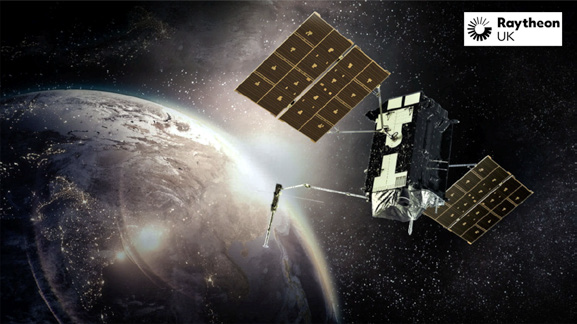 Under the contract, the UK Space Agency will gain access to Raytheon UK’s NORSSTrack software, which enhances orbital analysis and operational responsiveness by mapping and tracking satellites, monitoring potential collisions and debris, assessing re-entries and providing critical data for decision-making.
The analysts will be based at a National Space Operations Centre facility at Royal Air Force Base High Wycombe, delivering an analysis and response capability that underpins the UK’s growing leadership in space operations.
“Our orbital analysts are among the most capable in the industry,” said James Gray, chief executive and managing director of Raytheon UK. “We’ve invested heavily in developing this talent, particularly in the North-East, as part of our continued support of space domain awareness.”
 Space domain awareness remains a vital national capability, ensuring the UK can operate safely, securely and confidently in an increasingly contested space environment. As highlighted in the UK’s Strategic Defence Review, it is central to protecting critical space assets and strengthening resilience across government, defence and industry.
“Our continued partnership with Raytheon allows us to deliver key components of the National Space Operations Centre operations, analysis and response capability—clearly signalling our commitment to safeguarding UK and allied interests in an increasingly complex orbital environment,” said Angus Stewart, head of the National Space Operations Centre.
Raytheon UK’s continued partnership with the UK Space Agency, and investment in this strategically important domain, will help to ensure the country remains at the forefront of global leadership in space operations
and innovation.
Swarms: Equipping Drones with EW Capabilities
The modern battlespace is defined by contested and degraded environments where allies and adversaries compete for crucial bandwidth. To maintain a decisive advantage and degrade the capabilities of enemy forces, the U.S. and its allies require EW technology that is advanced as well as agile, resilient and scalable. That’s why Northrop Grumman has developed a compact yet powerful technology that can dominate in any environment.
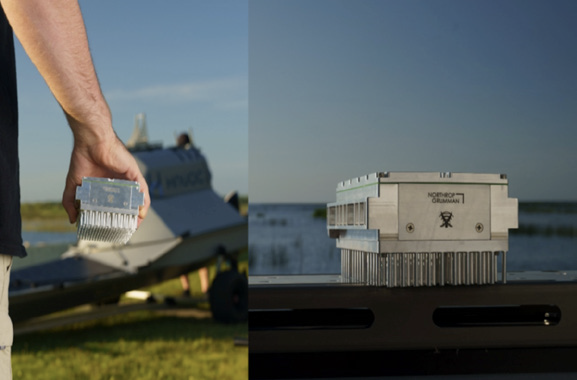
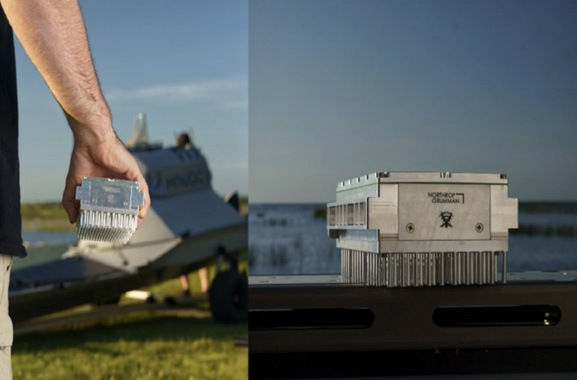
The Tactical Edge Electromagnetic Solutions (TEEMS) Tactical Edge Device packages “Rock Ridge,” Northrop Grumman’s state-of-the-art electronic warfare (EW) transceiver, into a compact 1U Modular Payload. (Photo Credit: Northrop Grumman)
At Silent Swarm 2025, an annual U.S. Navy demonstration of advanced EW for small, unmanned systems, Northrop Grumman delivered a live, proof-of-concept. On-site, the company integrated its Tactical Edge Electromagnetic Solutions (TEEMS) onto compact platforms—ranging from tiny robots to unmanned surface vessels and drones—demonstrating how these small systems can produce outsized impacts. With TEEMS embedded, these platforms become powerful tools capable of detecting and jamming enemy signs with speed and precision, ensuring superiority across every domain.
In contested environments, where every inch of space and ounce of weight matters, EW solutions must combine top-tier performance with ultra-efficient size, weight and power (SWaP) for mission flexibility. Northrop Grumman’s TEEMS solution integrates high-performance EW capabilities into a compact, 1U Modular Payload. Smaller than a business card, it was the smallest sysem at the event as well as the most capable, packing powerful performance into an unprecedented form factor. The demonstration was a testament to the power of resilient, scalable technologies, designed for mobility. While on-site, Northrop Grumman’s team:
Countered Evolving Threats: The team successfully geolocated a frequency-agile target emitter – which are known to be difficult to disrupt – and performed stand-in jamming.
Achieved Intelligent, Integrated Operations: Through the integration with Tactical Assault Kit software, the team remotely controlled multiple unmanned ground and surface units across a large, 50-square-mile operational area. The system’s ability to seamlessly coordinate with these diverse assets demonstrated its capacity for intelligent, integrated mission solutioning.
Maximized Combat Impact: In a single, simultaneous action, TEEMS knocked out three different radios that were spread across a wide frequency range.
Silent Swarm 2025 was a resounding success, not just for its technological achievements, but because it underscored our team’s ability to innovate and execute under pressure,” said Angela Johns, vice president, weapons integration and mission solutions, Northrop Grumman. “This effort reinforces our commitment to delivering mission-ready solutions tested in simulated environments and solidifying our role in advancing tactical operation dominance both today and in the future.”