

Linda Kane, Space Systems Command Public Affairs
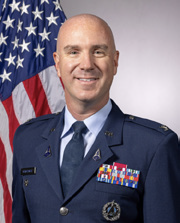
Colonel Andrew S. Menschner stepped into the role of deputy commander for Space Systems Command (SSC) in June of 2025. From SSC headquarters at Los Angeles Air Force Base (LAFB), he helps to lead more than 15,000 military, civilian, and contractor personnel worldwide and manages an organization that has an annual budget of $15.6 billion. Prior to this assignment, he served as commander of Mission Delta 31 at Space Operations Command (SpOC) at Peterson Space Force Base in Colorado and was responsible for operations, sustainment as well as acquisition of the Global Positioning System (GPS) constellation and Satellite Control Network.
SSC Public Affairs recently discussed with Colonel Menschner SSC’s evolution from a Center to a Field Command, the creation of Systems and Mission Deltas, and the day-to-day impacts on SSC Guardians during this unprecedented pivot in space acquisition culture.
Colonel Menschner, you transferred to the Space Force in 2022 after 21 years in the Air Force, primarily in the role of an acquisitions professional. How is space acquisition shaping up to be different from more traditional military acquisition?
Colonel Menschner
Every service organizes their acquisition activities differently. If you are in the Army, you do not commission as a 2nd Lieutenant in the acquisition world. You go and do operational things, and then you work in an acquisition capacity as a mid-grade or even senior officer on the technologies that you spent several years operating. That’s their process and it works for them.
The Space Force is a different animal. Our organization is still very new, and the entirety of our Force—SSC, SpOC and STARCOM—is smaller than the Army’s Third Infantry Division or the Air Force’s Acquisition Corps.
We don’t have the luxury of having a divide between our acquisition professionals and our operator teams. In that context, it should not be surprising to our Air Force members, or our former Air Force members, that the Space Force is going to go about acquisitions differently.
It would actually be more surprising if we just copied the Air Force model and didn’t change it. And so, we are changing it to create tighter ties between operation and acquisitions. We are growing up as a service in how we manage acquisitions and it’s exciting to be part of that change.
Previous to your current position, you were commander of the Space Force’s first prototype Mission Delta, working closely with SSC’s prototype System Delta on Positioning, Navigation and Timing (PNT). How did that experience inform your view of the new System Delta construct unfolding here at SSC?
Colonel Menschner
To me, the clearest example of the advantage of our new construct is the tight link that it creates between the capability development teams and the teams that will be operating those systems in the future.
During my tenure at Mission Delta 31, we saw this tight linkage really come to bear in moving along the OCX system. OCX is the next generation GPS ground system and has had years of delays and challenges with delivery.
By the time I stepped into the Mission Delta role, that relationship had become so broken that the squadron that was going to operate GPS had literally been ordered not to participate in OCX development testing.
One of my first moves was to erase that boundary and clearly articulate that it is the operating team’s job to help OCX get across the finish line. That was a Mission Delta action. The action on the capability development side—the System Delta —was to integrate those operators in and listen to their feedback.
There are many ways to foster this kind of linkage between Mission and System Deltas. What I did in the case of OCX was to create a dedicated crew of operators to OCX development testing and charge that team with helping me prioritize the things that absolutely needed to be fixed before OCX would go into operations. With that analysis, we were able to go into development meetings and test readiness reviews and be able to focus quite quickly on the problems that were critical to fix. And—just as importantly—be able to credibly say “that’s not an issue” and “it can wait.”
That’s an incredibly powerful dynamic because as a Mission Delta commander, through my relationship with the Systems Delta, I was in all of those conversations. I knew the capabilities of the system, the challenges in development, and the most critical gaps to be filled.
With that constant back-and-forth dialogue, we avoided the typical situation in which the operational acceptance decision period is the first time that operations is looking at a capability. Because we were part of the process all the way along, that tight linkage really allowed us to get after the problems that were the most important and to delay fixing the things that could wait until later. That kind of prioritization is what’s going to help us speed capability delivery more than anything else at the moment.
As SSC institutes System Deltas, what can Guardians expect to be different in their day-to-day work?
Colonel Menschner
We are going to be asking more of our workforce. We are going to ask them to be fluent in how their systems are operated and understand the operational environment that our capabilities will be used in. That’s a challenge because it is not the way we’ve historically done things.
When I was at SSC originally as a Materiel Leader, as an O5, at SSC’s predecessor Space and Missile Systems Center, I took risk on behalf of the operational commander every single day. I did so without fully understanding what he/she was going through because we did not have a tight linkage between acquisition and operations. We were working in a vacuum according to an established set of requirements and, only when we checked off every box, would we hand a capability over to operations.
In today’s environment, that no longer works. Today’s demand signal for capability is greater than it has ever been in the past and the risk tolerance on the operator side is much greater than we’ve ever seen.
What operators are telling us, in many cases, is that they would rather have 50% of a capability now and the other 50% later instead of waiting until we get to 100%. The requirements and the actual processes stay the same, but what changes is the communication and the prioritization. We are too small, and our nation is too dependent on the capabilities that the Space Force provides to our joint force to do any less.
The SSC Commander’s Line of Effort #3 calls for making better connections with our stakeholders. What can SSC do better to connect with our operations counterparts in Mission Deltas?
Colonel Menschner
First and foremost, we have to listen to feedback—not just solicit feedback but really listen to it and act on it—even when it’s hard to hear.
Our job as an acquisition professional is not to move from Milestone A to B to C. These are the activities that you need to do to get your mission done, but it is not your job. Your job is to deliver capabilities that deter our adversaries and, if necessary, defeat them in conflict.
That’s where the warfighter mindset comes in. We are warfighters first and acquisition professionals second. We need to really listen to feedback—from operations and from industry—even when it means that hitting our next milestone will become more difficult.
That’s the mindset shift that we are looking for and I need each and every member to be focused on delivering capability to the warfighter at—or even faster than—the speed of need.
Now that you’ve been in the SSC deputy commander seat for several months, what are your early impressions of the job?
Colonel Menschner
The motto of Space Systems Command is Space Starts Here, and every day our team is designing, building, and delivering combat ready space power that our Joint Force relies upon.
It’s our job to deliver those capabilities faster than our adversaries are able to do so, and it’s exciting to know that the work here makes a difference for today and every day into the future.
I’m really excited to be here as the deputy commander and I’m looking forward to everything we are going to do together. I really believe our Guardians and the Airmen who support them are the most talented team in the entire United States Space Force.
I’m excited to see the linkage between them and the operational mission grow. Once that happens, I really don’t think there’s anything that can stop us.
Do you have any words of advice to service members or new recruits interested in becoming Guardians?
Colonel Menschner
The first thing I would say is this: if you want to make a difference through your work every day, then this is the place to be. We are the newest service, we are focused on a new domain, and we’re doing things differently. We need to protect free access to space, respond to our enemy threats and actions, and innovate new methods of doing business.
The second item is that there’s really something for everyone in the Space Force and in Space Systems Command. Working in space has been one of the highlights of my career and I would absolutely recommend this career to everyone.
Space Systems Command is the U.S. Space Force field command responsible for acquiring, developing, and delivering resilient capabilities to outpace emerging threats and protect our Nation’s strategic advantage in, from, and to space. SSC manages a $15.6 billion annual space acquisition budget for the Department of Defense, working with joint forces, industry partners, government agencies, academia, and allied nations.
For more information, visit ssc.spaceforce.mil and follow
@USSF-SSC on LinkedIn.